Showing posts with label color chart. Show all posts

Thursday, January 24, 2019

Pigment Testing 52 Daniel Smith Paints

Daniel Smith makes some delicious colors, and I irresistibly have bought more than I need. I'm finding that a few of them are rather similar ... and yet different ... so thought I would test them out to see which pigments had the best texture, which could be textured through salt or other devices (and which ones didn't respond much to texturing attempts), which traveled the fastest in water and which ones tended to stay put, and of course which ones Daniel Smith announced as highly transparent and then whether I agreed or not based on outcome. 

I'm not writing down all the outcomes I noted. Wow, would that take time since there are indeed 52 here! But the charts below can be tapped on and enlarged and the various outcomes do become quite apparent. One regret I have in making this chart is, I was particularly interested in texturing with cotton netting gauze; however, I pigmented that area too much so the gauze hashtag effect is rather obscured. Ah well. I'll know better when it comes time for practical application!


The Legend ... for comprehending the transparency and texturing tests for this chart:


52 Daniel Smith colors pigment tested for transparency and texturing

DS pigment test outcomes remarkably lovely here!

The DS reds and pinks were weaker on texturing effects than the blues, greens and earth tones.

Wednesday, February 28, 2018

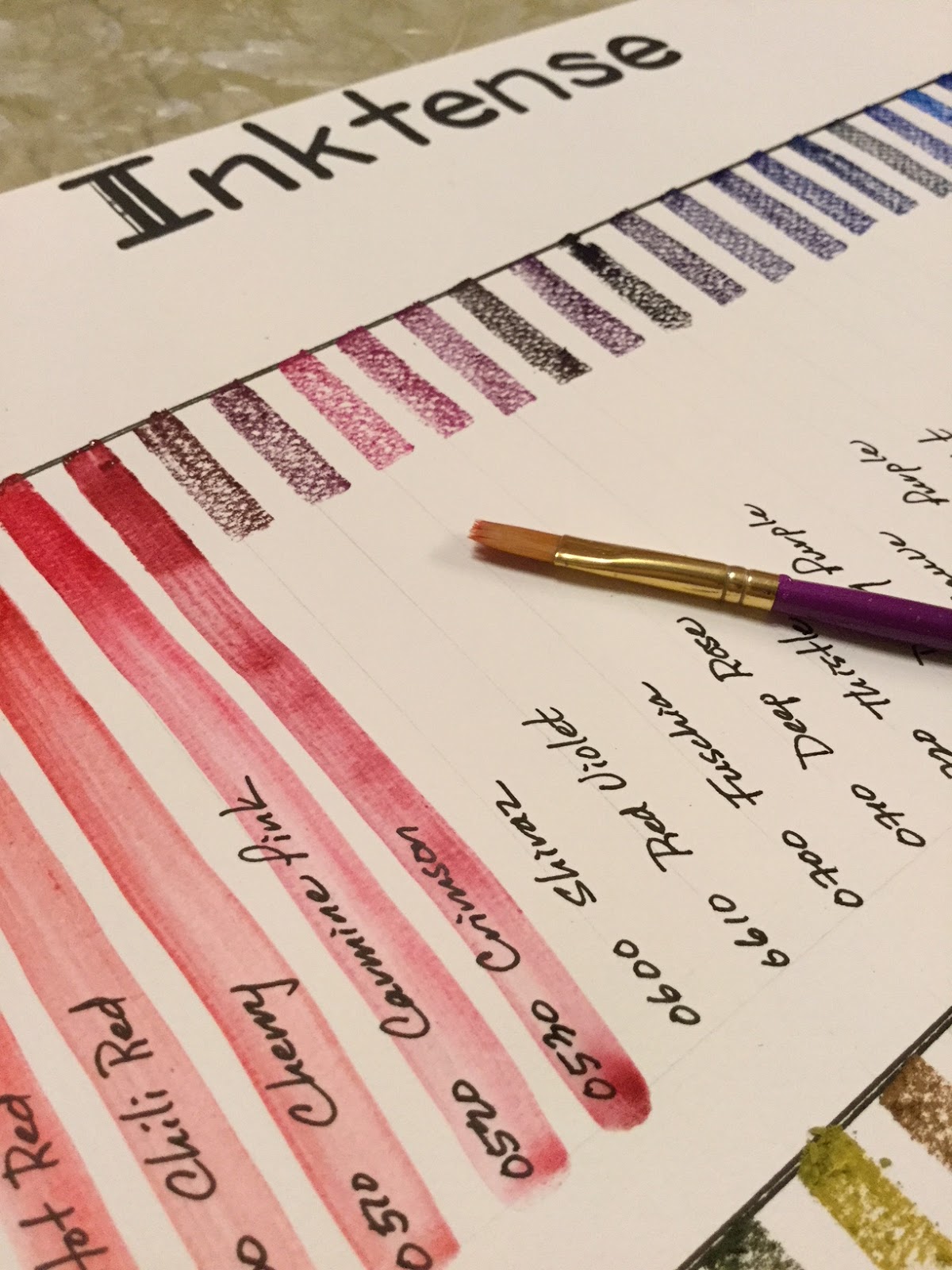
Derwent Inktense Color-swatch Chart

Derwent 72-color Inktense are gorgeous, rich, and intense. I also recently bought the Derwent Artbars, very different on many levels, but I will make some basic compare-and-contrast statements that aren't commonly written about.


Derwent Artbars (72 colors)
Derwent Inktense (72 colors)
Medium
Watercolor paints. Can be reactivated every time the painting is dampened, so layers are fragile and can be disturbed, but they allow more spontaneity as they can be changed if desired.
Ink—once activated with water and dried, doesn’t reactivate so takes layers very well! Once permanent, cannot be changed, so plan ahead.
Intensity
Pastel-like. Colors are grouped into four categories: brights, lights, earths, darks. I found the lights almost too pastel to be very useful. Marigold and carnation in the brights also extremely pale as were a couple in the earths (spice and Mediterranean especially).
For the most part these colors are powerful. A few like saddle brown, baked earth and willow and a couple of others were weak on intensity, but then I was only color-swatching and wetting with one steady swipe.
3-4cm crayon-like application and activation with water (one-swipe)
Activate quickly and the color is very smooth and evenly distributed.**** Applause, applause!
Activate quickly but consistently streak affecting even distribution of color.
Residue after one-swipe activation of crayon swatch
About 80% “melted” by the water
About 70% “melted” by the water
Color pulls down in 6-7 inch swatches
Color pulls down smoothly, easily, and except for lights, consistently
Color pulls down easily and  consistently but in streaks

Uses for me
On paper just like traditional watercolor paints, but they can be used to draw and then activated with water.
On paper light traditional paint, as a crayon and activated, and on cloth with textile medium—all permanent once dried.
Both of these mediums easily activate with a damp paintbrush on the bars themselves, eliminating the need for a palette or clean-up after painting—for me in my tiny apartment, this is phenomenal! Easy set-up and easy put-away!

awesome color, but note the streaking with the one-swipe water activation of the crayon-like application to paper
Derwent Inktense color-swatches
(compare with Derwent Artbars)
I was rather surprised that the Inktense set didn't come with a list of color names, but only had 4-digit numbers on each of the bars. Some of those numbers were very hard to see too. I actually had to go online to get a list of the color names to match the numbers, a bit of an inconvenience!

Then, thank goodness, I carefully checked each of the 4-digit numbers to the name on the list and found an error. There was no "Outline #2400" but I did have the Unknown blue color #1215. Very odd, with double meaning to that word as it was the only odd number in the 72-color set. All other bars were numbered roughly in 10-number increments. One of the reasons I checked the numbers before just labeling the bars is someone else online had complained of getting two bars of the same green color; she wrote the seller and was immediately sent the missing color. For me it's really no big deal, since at least all 72 of my colors are uniquely different.
After making sure of color of each bar, I labeled each so I can easily document which colors are used on future paintings.

And now all of my colors are clearly labeled and ready to use. Also note the little yellow tabs on the top pan. I put a cardboard piece under the fragile plastic form and attached the yellow tabs so I can easily pull the thin plastic palette out without damaging it. Now it feels quite durable and should last a good long time!

Monday, January 29, 2018

Daniel Smith+ 31-color palette

So finally set up and painted out my professional watercolor palette. It's comprised of 31 Daniel Smith paints, several of which are the earthy primatek colors, 4 Winsor & Newtons, and 5 M Grahams. I'm trying to use up the M Grahams, lovely colors, but messy because of the gooey honey used in the formula. If I used my colors only in a studio, I would absolutely treasure my rich M Grahams, but the traveler has a messy paintbox because of the gooey paints, especially Pyrrol Scarlet, not a color anyone wants going all over their paintbox!


After I put together my colors and painted them out, my palette still had an empty lower left corner so added in the rich M Graham azo green (it's a bit less yellow than the W&N green gold already in the palette) and the three Turner paints: Alizarin Crimson (no one makes a color-fast AC so got a cheap color to test out what the rave on the color was about), copper (how absolutely lovely!) and clove (opaque but beautiful color no one else has). 


After painting 39 of the colors out (didn't include Buff Titanium as I can guess what the combinations would be), I realize I went a little heavier on earth tones than I intended, but in my defense my interest is animal painting and the colors I bought were mostly single pigment so capable of mixing with any other single pigment for "good" mixing qualities.

Thursday, January 25, 2018

Daniel Smith 240-color Chart

Daniel Smith has an extensive selection of watercolors, and while I can look online to see the color charts of others, sometimes it's hard to tell about intensity and mixing qualities of certain colors or even about how it looks in comparison with colors in other brands I'm more familiar with, so I ordered the DS 240-color-dot cards to paint out the sample of watercolors for myself.

If you turn the above chart 90-degrees to the left,
the 4 groups of colors are exact representations of the 4 DS 240-color dot-cards. 

The blues, greens and earth tones got my closest attention as I'm most interested in making animal paintings. One color that I was really looking forward to testing out was Yavapai, a yellow-brown ochre-like color; I wanted to see how it compared with raw sienna and goethite, but from this chart and looking at online samples I'm thinking that Monte Amiata might be a better color choice as Yavapai seems a bit browner than what I'm looking for. However, still not sure as Yavapai was NOT included in the 240-color selection. Bit disappointed, but I did learn a LOT and made shifts in what colors I would and would not get in the future.